 According to a quick Google search, Pittsburgh International Airport saw around 9 million passengers in 2018. Chicago Midway had 22 million. Tampa had around 21 million. My airport saw just over 8 million passengers – the most ever. That’s great! Or is it? How does an airport know whether the number of passengers they are serving is good or not?
Load factors
One useful metric is the load factor. You may have seen this used to determine how well an airline is performing in general, but in this case airports are looking specifically at the load factors for flights into and out of their cities. In the simplest sense, the load factor is a measure of how full the flights are. It is calculated by comparing the number of paying passengers against the total number of seats that were available. For example, if ABC Airlines had 5 flights in and 5 flights out of the airport and used airplanes with 100 seats each, that’s a total of 1,000 seats available. If each plane had 75 paying passengers on board, then there were 750 passengers total, and the load factor is 75%.
 I can’t speak to how other airports collect passenger data, but my airport does it via monthly reports that are submitted by the airlines. Each report includes the type of planes used, the number of landings for each, the number of passengers, etc. From that information we can determine the total number of seats and, in turn, calculate the load factors for each airline, as well as an average load factor for all flights during the month.
Higher load factors mean fuller airplanes which means better profit margins for the airlines. When flights aren’t profitable guess what usually happens? Yep – they go away. Not good! While the monthly load factors are useful, it is also important to look at trends over time. Comparing the numbers from the last few years I noticed that the average monthly load factor at my airport has increased more than 5% – and it was fairly strong to begin with. We definitely like to see that!
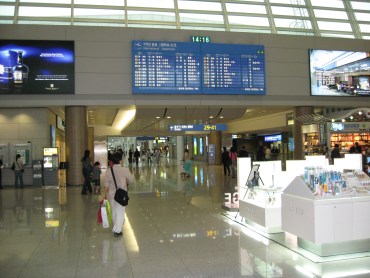
Photo by Jnpet, Creative Commons License
Heavier metal
Of course load factors are just one piece of the story. Another metric to look at is the types of planes that are being used, and how that usage shifts over time. A high load factor on a small plane is good. But when the number of passengers becomes strong enough to justify moving up to a bigger airplane, that’s better. And when the load factors start growing on the bigger airplane, that’s better still!
Let’s take the humble CRJ for example. To keep it simple I’ll combine the stats for the 200, 700 and 900 together. In February 2019 there were roughly 100 fewer CRJ landings than in February 2018. However, there were 100 more Airbus 319/320 landings, and 50 more Boeing 737 landings. Some of those increases were due to added flights and Mad Dogs being retired, but many were the result of a shift to bigger mainline planes and fewer regional ones. That comes out to several thousand more seats available in February 2019 vs 2018. At the same time, the load factors remained strong. Yes! That makes us very happy! (Don’t you worry – we still love the CRJ! Although the number of flights may have decreased, we still see PLENTY of them around.)
 Max effect
You may be wondering what kind of impact the grounding of the Boeing 737 Max is having on all this. That’s a fairly complex matter. Certainly there have been some cancellations. Looking just at the airlines that fly the Max into my airport and comparing the number of flights that were scheduled against the number of flights that actually happened, there was a drop of about 3%. That may not seem like a high number, but then again, that was just for half the month. It remains to be seen what the long term implications will be. If you are curious to know how an airline copes when some of its planes are grounded, the Flying and Life Podcast gave a really good overview of what steps they have to take to re-book stranded passengers and rework their schedules. I strongly encourage you to check it out!
Lies, Damn Lies and…
The numbers are, of course, just a snapshot in time and there are a whole lot of factors that the airlines consider when deciding which planes to fly on what routes. Things can change from month to month and season to season. That’s why the airport has people much smarter than myself who track and analyze all this data. But every now and then I like to take a peek and see how things are looking. Maybe one of these days I’ll see an A350 on the stats sheet. Or a 777! OK, so it’s not very likely. But, hey – an avgeek can dream!

Not an airliner. I just couldn’t resist adding a pic of this sweet bizjet!
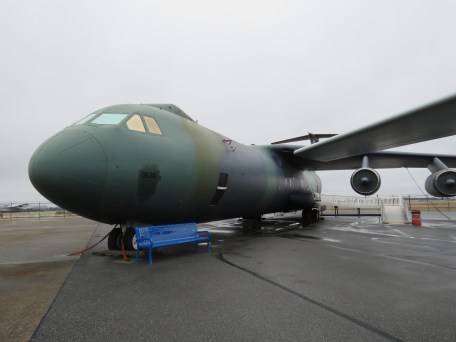
 In my part of the world, winter means lousy weather, cold temps and very little plane spotting. It also means I go through serious aviation withdrawals. Ugh! So how do I combat the winter doldrums? Aviation museums! They allow me to get my aviation fix and keep my camera from getting too dusty. Recently I got the opportunity to visit a museum I hadn’t been to before: the



 One thing I learned early on at my job is that you don’t have to be an aviation enthusiast to work at an airport. In fact, most of the people I work with, while very talented and quite passionate about what they do, aren’t at all interested in airplanes. And that’s OK. But I know there have to be avgeeks hiding out somewhere – the challenge has been finding them.
 Over time I pretty much gave up on the idea of tracking down other airport avgeeks. But all that changed last summer in an unexpected way. Did I stumble across a magic device for detecting aviation lovers? Well… kind-of. And what, you ask, is the secret to unveiling hidden avgeeks? An A220 lanyard! Who’d have guessed!
 Have you seen the A220?
 Do You Work For Delta?
 A220, eh? My airline ordered a bunch of them but won’t be flying them.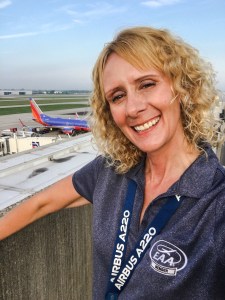


 Then there’s the runways. At the passenger airport we have a very respectable set of parallel runways. Same at the cargo airport. They suit our needs quite adequately. But… well… they’re not very imaginative. Other airports have really upped their runway game. Take O’Hare for example. It has a variety of runway sizes and orientations. Or what about Boston Logan whose runways all seem to intersect with each other. I can only imagine how that went down:


 The dictionary defines an ambassador as, “a person who acts as a representative or a promoter of a specified activity or organization.” For me it simply means that when you really love something, you can’t help but share that passion with others. Recently I had the opportunity to share my love of aviation in some different and unexpected ways.
 I wasn’t the only one enamoured with the airplanes. One of the race participants completely abandoned any pretense of running when she saw them. She pointed at the planes and said, “I’m not here for the race, I’m here for THIS!” The smile on her face made me realize that the airport 5K is so much more than just a race. It allows the community to connect with aviation and the airport in ways it wouldn’t otherwise be able to.
 There were three other people on the panel with me – an FO with a regional airline, a pilot with a private charter company, and a former airline pilot now flying business jets. We were asked to talk about our careers and we answered questions from the audience. I talked about my love of airports and how fortunate I am to work for one.
 Perhaps the most surprising outreach opportunity came as the result of a
 I saw a video on twitter recently of a baggage handler behaving badly. The person who tweeted the video tagged the airport to complain. Other people chimed in as well, demanding that the airport take action. The problem is, baggage handlers are not actually airport employees. They work AT the airport but they don’t work FOR the airport. The media often makes the same mistake. More than once I’ve come across a headline proclaiming “Airport Employees Accused of…” only to learn that the people in question are employed by some other company that just happens to do business out of the airport.
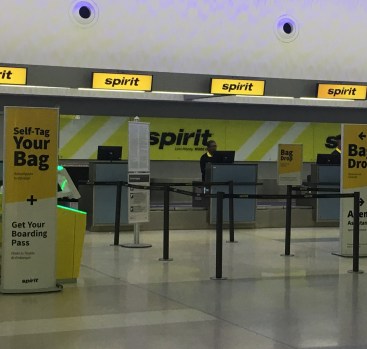 Ticket Counter and Gate Agents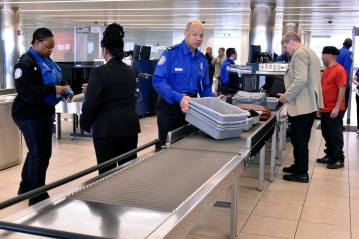
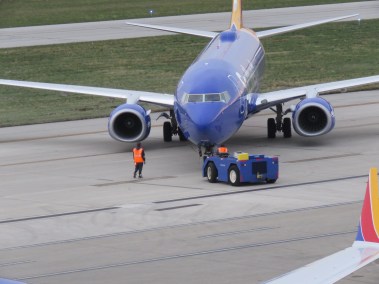 Custodians and Building Maintenance:
 You may be wondering: don’t airports have ANY authority over the people who work there, even if they work for another company? Well… yes. Sort-of. The airport is responsible for issuing SIDA (Secure Identification Area) badges to anyone who works in secure areas, regardless of who their employer is. If someone violates SIDA rules then the airport can revoke their clearance, effectively preventing them from being able to work.
 I’ve got a thing for ATC towers. Who doesn’t, right? They’ve got the best view in the world! I’ve been staring longingly up at the tower at my airport since I started working there, wishing that I could get inside. I think they are aware of this because they keep adding more and more “no trespassing” signs along the fence.
 But… there’s still that tower at work. The one I park next to every day. The one whose controllers I listen to all the time. I’ve heard them handle emergencies and bad weather and single runway ops. Heck, I’ve even spoken to them when I helped on the deice pad. I feel like I know these people! I’m their biggest fan! And yet, this tower has remained out of reach…
 First stop was the cab. Wow. Just… wow! No other way to describe it! The view was spectacular. The planes look so small from up there! Getting to see the airport from that vantage point was both incredible and informative. For example, I learned that the tower does not have a good view of the deice pad because it is hidden by the terminal building. I didn’t realize that before.
 All too soon our cab visit ended and as you might expect, I REALLY didn’t want to leave. I was prepared with a whole list of reasons why they should let me stay:
 The first thing I noticed when I entered the room was that it is dark. Really dark. It took a minute for my eyes to adjust. When they did, I saw lots of computer stations. The controllers who work here not only handle approach and departure for my airport, but they handle all the traffic below 10,000 feet for most of the state. (There apparently used to be two TRACONS that got combined into one, which is why they cover so much territory.)
 There was definitely a different vibe in the TRACON vs. the cab. In the TRACON the focus is entirely on the computer screens. The controllers have a lot of airspace to manage and the atmosphere felt a little more intense. In the cab the focus is on the world outside the windows. The most important thing, however, is how it all fits together to keep things running smoothly and safely.
 Everyone knows how much I love airplanes. However, I’ve always liked classic cars too. A couple years ago I inherited a 1954 MG TF 1500 from my father. It’s not the kind of classic car I imagined I might have, but the more I’ve gotten to know it, the more I’ve come to love it. When I found out there was going to be a Cruise-In/Fly-In nearby I was super excited. Spend the day at an airport with airplanes AND classic cars? Oh heck yeah!
 The first thing I noticed when we arrived at the airport was all the cars – they had a great turn-out for the cruise-in! There were plenty of American classics, of course, but there were some imports as well, including another old MG. There were also a lot of airplanes. The fly-in covered just about every aspect of aviation you can think of. There were drones and RC planes. There were flight simulators. The NASA “Journey to Tomorrow” traveling exhibit was there along with a shuttle astronaut who was signing autographs. Several university aviation programs had booths set up. And of course they had rides – a helicopter, a bi-plane and a C-47 were all coming and going with passengers on board. However, I was most excited about the Ford Tri Motor.




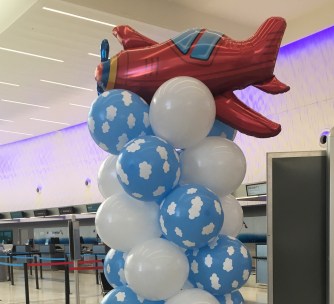 For the first time in a long time (and possibly ever) my airport celebrated National Aviation Day! I used to bring in cupcakes and host a little celebration just for my department. This year, however, the suggestion was made to scale it up and involve the entire airport. A team of employees planned the event, which included music, popcorn, a paper airplane contest, historical artifacts and more. I can’t begin to tell you how awesome it was to see so many people celebrating our industry and our history.




 I didn’t think anything could top my Wednesday

 The expression “only at Osh” is often used by attendees to indicate an event or happening that is unique to Airventure. I had several of those moments. Visiting the ATC tower was one. Meeting Sean D Tucker was definitely another. Another happened when Mike’s friend told us we could find him “near the T-6 with the flag.” At any other event that would be sufficient information to find his location. At Osh, however, we searched row after row after row of T-6s and eventually had to call back for a better meeting spot.


 Tales from the Terminal